
ai security
FGSM: Story of how I tricked a neural net with one gradient step
Sat Aug 15 2026
Same dog. Same photo, almost pixel for pixel. And the model just goes: “yeah, actually it’s a cat, 80% sure.” Seriously.
Here’s exactly what happened. I took the sample dog photo this repo’s demo ships with, fed it to a pretrained ResNet18. It said “Samoyed,” 83.72% confidence, no argument. Then I added a perturbation so small you can’t see it with your eyes: one gradient computation, no retraining, no extra data, no access to anything but the model’s gradient. Fed it in again: “Siamese cat,” 80.15% confidence.
This isn’t some bug in my code. It’s not a fluke. It’s a fundamental property of how these networks work in the first place. There’s a name for this: FGSM, Fast Gradient Sign Method. Goodfellow, Shlens, and Szegedy published the paper in 2014, and the core claim was almost rude in its simplicity: neural networks aren’t fooled because they’re “too nonlinear and complex,” they’re fooled because they’re too linear. A model that behaves close to linearly in high-dimensional input space will accumulate a lot of change in its output from many tiny, coordinated changes in its input, even if each individual pixel moves by less than what a human eye can register.
If you’ve done any red-teaming against LLMs, the shape of this should feel familiar: you’re not looking for a big, obvious flaw, you’re looking for a small, structured nudge that the model’s decision boundary is sensitive to. FGSM is that idea applied to image classifiers, and it’s the baseline every other adversarial-robustness technique gets compared against.
This is a white-box attack: you need gradient access to the model. That’s a real constraint, since you can’t FGSM a model behind an API you can only query. But it’s also exactly why it matters for testing: if you own the model or you’re evaluating one before shipping it, white-box access is what you have, and FGSM is the cheapest possible check of “does this thing fold under a single coordinated push.”
The idea, without the paper’s notation
You want to find a perturbation η (eta) that increases the model’s loss with respect to the true label, subject to a budget: no pixel is allowed to move by more than ε (epsilon). This is an L∞ constraint, not an L2 one, because it’s modeling “how much can any single pixel change,” not “how much total energy is in the perturbation.”
Under a linear approximation, the perturbation that maximizes loss increase for a given L∞ budget is:
η = ε · sign(∇ₓ loss(model(x), true_label))
Take the gradient of the loss with respect to the input pixels (not the weights, since you’re not training anything), keep only its sign (+1, -1, or 0 per pixel), scale by epsilon, add it to the image, clamp back to a valid pixel range. One step. That’s the whole attack.
What this looks like in code
Here’s the untargeted version, trimmed to the actual attack step (full file linked below):
def fgsm_untargeted(x_01, true_label, epsilon):
    x_01 = x_01.clone().detach().to(DEVICE)
    x_01.requires_grad_(True)          # gradient w.r.t. PIXELS, not weights

    x_norm = normalize(x_01)
    logits = model(x_norm.unsqueeze(0))
    loss = F.cross_entropy(logits, torch.tensor([true_label]).to(DEVICE))

    model.zero_grad()
    loss.backward()

    with torch.no_grad():
        x_adv = x_01 + epsilon * x_01.grad.sign()
        x_adv = torch.clamp(x_adv, 0, 1)

    return x_adv.cpu()
Two details worth calling out because they’re the parts people get wrong on a first implementation:
x_01.requires_grad_(True)is set on the image, not on any model parameter.param.requires_grad = Falseis set for every model weight elsewhere in the script, since you’re explicitly not training here, you’re differentiating the loss with respect to the input.- The attack operates in
[0, 1]unnormalized pixel space, andnormalize()is a separate step applied only right before the forward pass. That’s deliberate: epsilon needs to mean “this many units of raw pixel intensity” for theL∞budget to be physically meaningful. If you computed the gradient sign in normalized space instead, epsilon would mean something different per channel (because mean/std differ per channel), and your perturbation budget would stop being an honestL∞ball.
Running it
git clone https://github.com/BogiLoco/FGSM
cd FGSM
python3 -m venv venv && source venv/bin/activate
pip install torch torchvision matplotlib pillow requests
python fgsm.py
No training, no dataset download: it pulls a pretrained ResNet18 (ImageNet-1K weights) from torchvision and a sample image on first run. It runs an untargeted attack, then an epsilon sweep: the same attack repeated at increasing budgets, so you can see the exact point where the model’s prediction flips.
Everything here runs against a resnet18 instance in your own process, on an image you pass in. There’s no target system to reach, no API to hit. That’s also its limit: this technique needs white-box gradient access, so it says nothing about how a black-box, API-fronted model would hold up.
A single untargeted step at eps=8/255 does this: original, the perturbation itself (amplified so you can actually see it), and the result.
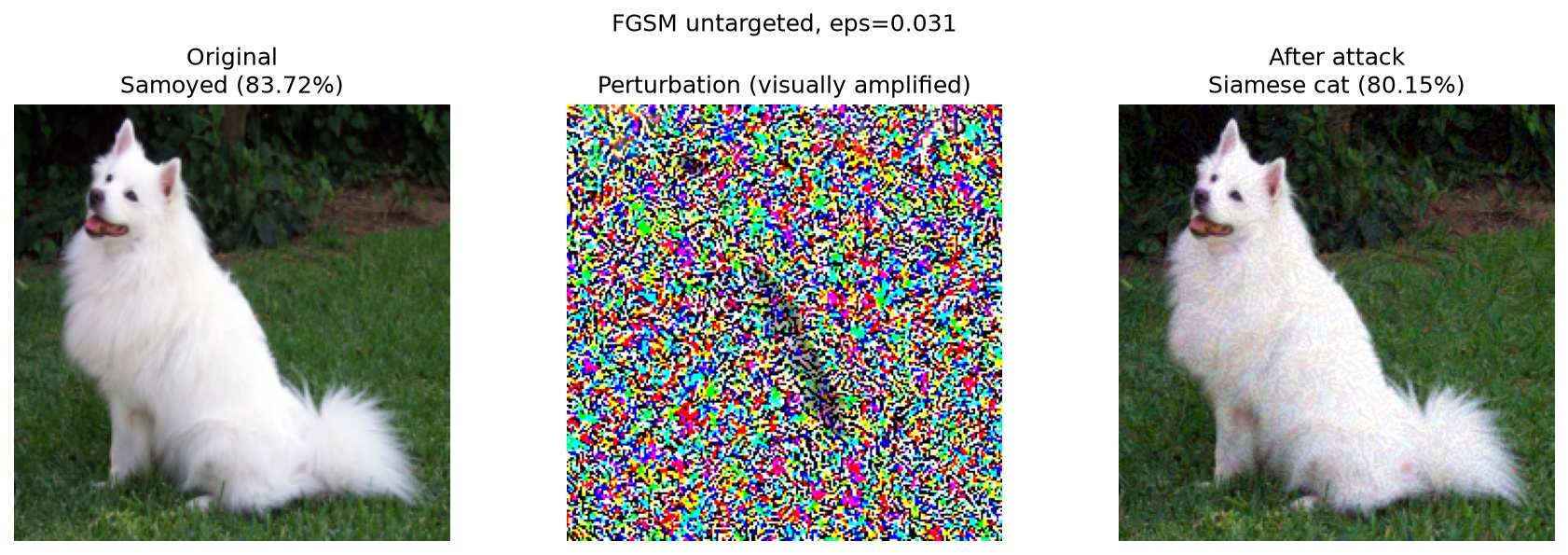
The middle panel is the entire attack: epsilon * sign(gradient), visualized. It looks like structured noise because it is: every pixel moved by the maximum amount the sign of the gradient allowed, which is why it’s uniformly speckled rather than concentrated on any one visually meaningful region.
Here’s the full epsilon sweep for the same image:
   epsilon | prediction                | confidence
----------------------------------------------------
    0.0000 | Samoyed                   |    83.72%
    0.0039 | white wolf                |    40.42%  <- attack successful!
    0.0078 | lynx                      |    20.05%  <- attack successful!
    0.0157 | Siamese cat               |    39.27%  <- attack successful!
    0.0314 | Siamese cat               |    80.15%  <- attack successful!
    0.0627 | Siamese cat               |    90.37%  <- attack successful!
    0.1255 | West Highland white terrier |    41.27%  <- attack successful!
Notice the confidence doesn’t monotonically fall as epsilon grows. It dips hard around eps=0.0078 (down to 20%, a genuinely uncertain model), then recovers to 90% by eps=0.0627, just now confidently wrong about “Siamese cat” instead of confidently right about “Samoyed.” Low confidence turns out to be a transient state on the way to a new, equally confident, wrong answer, not a stable “I don’t know.” That’s the property that makes adversarial robustness a real testing problem and not just a calibration problem.
The repo also ships a targeted variant, fgsm_targeted(): same attack, one change. Instead of maximizing the loss against the true label, it minimizes the loss against a label you choose, and steps against the gradient instead of with it. It’s a one-line diff from the untargeted version. Worth trying yourself, since aiming at a specific class turns out to be a meaningfully harder problem than “anything but the truth” for a single linear step. Code and both variants: github.com/BogiLoco/FGSM.
Before you go
- FGSM is a smoke test, not a robustness certification. A single linear step is often enough to push a model off its correct answer, as the run above shows, but pushing it toward one specific wrong answer is a meaningfully harder problem for a single step to solve. That’s exactly the gap PGD closes by iterating and re-aiming after every step. If “not FGSM-attackable” is part of a security claim, treat it as a floor, not a ceiling: it means nothing folded to the cheapest attack, not that nothing folds to a real one.
ε = 8/255is the de facto standard budget for ImageNet-scaleL∞evals in the literature: small enough to be visually imperceptible on natural images, large enough that most undefended models fail. Use it as your default when you don’t have a task-specific reason to pick something else, and always report which epsilon you tested at. “Robust to FGSM” without an epsilon is a meaningless claim.- This only applies to white-box, differentiable models. No gradient access (a model hidden behind an inference API) means no FGSM; you’d need a transfer attack (craft on a substitute model, hope it transfers) or a black-box/query-based method instead. Don’t reach for FGSM when what you actually have is API access.
- Targeted FGSM (
fgsm_targeted()in the repo) is a harder ask than untargeted. It’s the same one-step math with the sign flipped and the loss minimized against a chosen label instead of maximized against the true one, but steering a model toward one specific wrong class in a single linear step is much less reliable than just pushing it off the correct one. If your threat model cares about an attacker aiming at a particular outcome (not just “cause any misclassification”), test with the targeted variant specifically. An untargeted-only robustness check will miss this failure mode, and if it doesn’t land at a reasonable epsilon, that’s a sign to reach for PGD rather than concluding the model is safe from targeted attacks. - A confidence dip isn’t a permanent state. Don’t read it as “the model is being appropriately cautious.” In the sweep above, confidence bottoms out at 20% mid-attack and then climbs back to 90%, just now attached to the wrong class. A monitor that only alerts on low confidence would fire briefly, then go quiet right as the model settles into being confidently wrong.
- The full runnable code, including the targeted variant and the epsilon sweep implementation, is at github.com/BogiLoco/FGSM (MIT licensed; README covers setup and how to point it at your own image).